Australians Can Now Get 3 Hours of Free Electricity a Day — But Is It Actually Cheaper?
9 September 2026 · By SwitchLoop
Australia’s new Solar Sharer scheme offers eligible households three hours of free electricity a day. But is it really cheaper? Here’s what households need to know before switching plans.

Australians Can Now Get 3 Hours of Free Electricity a Day — But Is It Actually Cheaper?
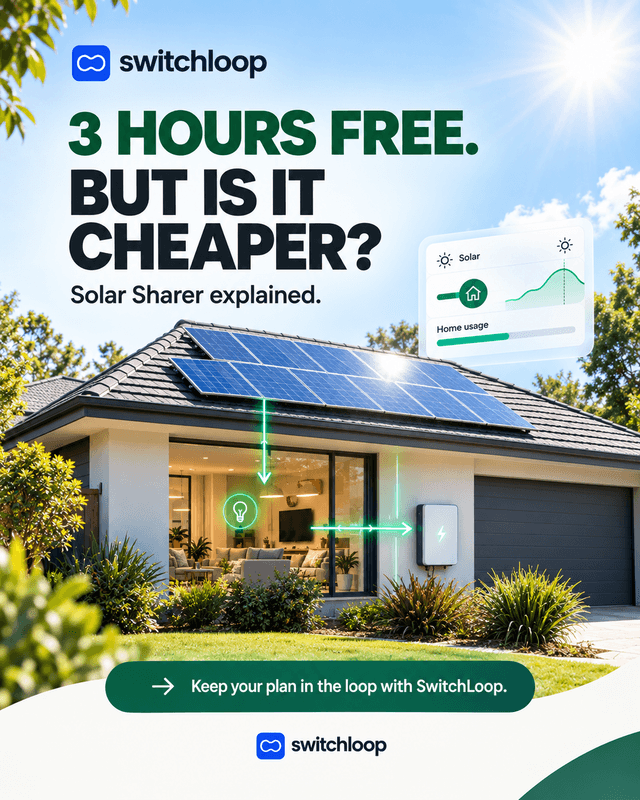
Imagine opening your electricity bill and knowing that, for three hours every day, the electricity you use costs nothing.
That is now possible for eligible households in parts of Australia through the Solar Sharer Offer (SSO), a new regulated electricity offer introduced on 1 July 2026.
But there is an important catch: free electricity does not automatically mean the cheapest electricity plan.
The Solar Sharer Offer is currently available to eligible households with smart meters in New South Wales, South Australia and South East Queensland. The free electricity window runs from 11am to 2pm in NSW and South East Queensland, and from 12pm to 3pm in South Australia. Households can use up to 24 kWh during the free period before additional usage is charged.
So, is it actually cheaper?
It depends on how your household uses electricity
The Solar Sharer Offer is designed for households that can move some of their electricity consumption into the middle of the day.
For example, you could run your washing machine, dishwasher, dryer or electric vehicle charger during the free period. The government also suggests using timers and smart appliance settings to shift consumption into the three-hour window.
This could make a significant difference for some households.
Recent analysis reported that households with electric vehicles could potentially save hundreds of dollars a year by charging during the free period. However, the potential benefit depends heavily on individual usage patterns.
And that's the important part.
You are not getting a completely free electricity bill.
You still pay the daily supply charge and pay for electricity consumed outside the free period. The rates applying outside the free window therefore matter just as much as the headline "free electricity" offer.
The cheapest-looking plan isn't always the cheapest plan
This is where electricity plan comparison becomes important.
A plan can advertise free electricity while having different supply charges or usage rates outside the free period. If your household uses most of its electricity in the evening, for example, you may not benefit as much as a household that can shift substantial usage into the middle of the day.
The Australian Government itself recommends comparing the Solar Sharer rates during and outside the free period with your existing plan before switching.
And this highlights a bigger problem with choosing electricity plans.
Your cheapest plan today may not remain your cheapest plan tomorrow.
Your usage can change. Retailers can change offers. New plans can enter the market. Government schemes can change the options available to households.
This is where continuous monitoring matters
Instead of checking your electricity plan once and forgetting about it, imagine having a system continuously looking for better options.
That's the idea behind SwitchLoop
SwitchLoop is built around a simple cycle:
Monitor your electricity plan → switch when a better option is available → monitor again.
The goal isn't simply to find a plan with an attractive headline. It's to keep checking whether your current electricity arrangement still makes sense.
The Solar Sharer Offer is a perfect example.
A new offer can look exciting today, but the real question is:
Is it actually cheaper for your household?
And once you find the right plan, the next question is:
Will it still be the right plan months from now?
That's why electricity comparison shouldn't be a one-time activity.
Your energy plan should keep earning its place on your bill.